 Users today expect mobile websites to load super fast. The reality is that it can often take several seconds. It is no surprise that 40% of people abandon a website that takes more than 3 seconds to load. To reduce the time content takes to get to a user’s mobile device we started working on the Accelerated Mobile Pages Project, an open source initiative to improve the mobile web experience for everyone.
Accelerated Mobile Pages are HTML pages that take advantage of various technical approaches to prioritize speed and a faster experience for users by loading content almost instantaneously.
Later this year, all types of sites that create AMP pages will have expanded exposureacross the entire Google Mobile Search results page, like e-commerce, entertainment, travel, recipe sites and many more. Visit the “Who” page on AMPProject.org for a flavour of some of the sites already creating AMP content and try the demo at (g.co/ampdemo) to see AMP versions of pages labeled with
 .
.

In advance of AMP expanding in Google Search, over the next few weeks we’ll be posting pointers to help you #AMPlify your site. Follow along with the #AMPlify hashtag on G+ and Twitter.
Have you already built AMP pages for your site? Share your feedback in the comments below or on our Google Webmasters Google+ page. Or as usual, if you have any questions or need help, feel free to post in our Webmasters Help Forum.


A reminder about widget links
Thursday, September 08, 2016
Google has long taken a strong stance against links that manipulate a site’s PageRank. Today we would like to reiterate our policy on the creation of keyword-rich, hidden or low-quality links embedded in widgets that are distributed across various sites.
Widgets can help website owners enrich the experience of their site and engage users. However, some widgets add links to a site that a webmaster did not editorially place and contain anchor text that the webmaster does not control. Because these links are not naturally placed, they're considered a violation of Google Webmaster Guidelines.
Below you can find the examples of widgets which contain links that violate Google Webmaster Guidelines:


Google's webspam team may take manual actions on unnatural links. When a manual action is taken, Google will notify the site owners through Search Console. If you receive such a warning for unnatural links to your site and you use links in widgets to promote your site, we recommend resolving these issues and requesting reconsideration.
You can resolve issues with unnatural links by making sure they don't pass PageRank. To do this, add a rel="nofollow" attribute on the widget links or remove the links entirely. After fixing or removing widget links and any other unnatural links to your site, let Google know about your change by submitting a reconsideration request in Search Console. Once the request has been reviewed, you'll get a notification about whether the reconsideration request was successful or not.
Also, we would like to remind webmasters who use widgets on their sites to check those widgets for any unnatural links. Add a rel="nofollow" attribute on those unnatural links or remove the links entirely from the widget.
For more information, please watch our video about widget links and refer to ourWebmaster Guidelines on Link Schemes. Additionally, feel free to ask questions in ourWebmaster Help Forums, where a community of webmasters can help with their experience.
Widgets can help website owners enrich the experience of their site and engage users. However, some widgets add links to a site that a webmaster did not editorially place and contain anchor text that the webmaster does not control. Because these links are not naturally placed, they're considered a violation of Google Webmaster Guidelines.
Below you can find the examples of widgets which contain links that violate Google Webmaster Guidelines:


Google's webspam team may take manual actions on unnatural links. When a manual action is taken, Google will notify the site owners through Search Console. If you receive such a warning for unnatural links to your site and you use links in widgets to promote your site, we recommend resolving these issues and requesting reconsideration.
You can resolve issues with unnatural links by making sure they don't pass PageRank. To do this, add a rel="nofollow" attribute on the widget links or remove the links entirely. After fixing or removing widget links and any other unnatural links to your site, let Google know about your change by submitting a reconsideration request in Search Console. Once the request has been reviewed, you'll get a notification about whether the reconsideration request was successful or not.
Also, we would like to remind webmasters who use widgets on their sites to check those widgets for any unnatural links. Add a rel="nofollow" attribute on those unnatural links or remove the links entirely from the widget.
For more information, please watch our video about widget links and refer to ourWebmaster Guidelines on Link Schemes. Additionally, feel free to ask questions in ourWebmaster Help Forums, where a community of webmasters can help with their experience.
Showcase your site’s reviews in Search
Wednesday, September 07, 2016
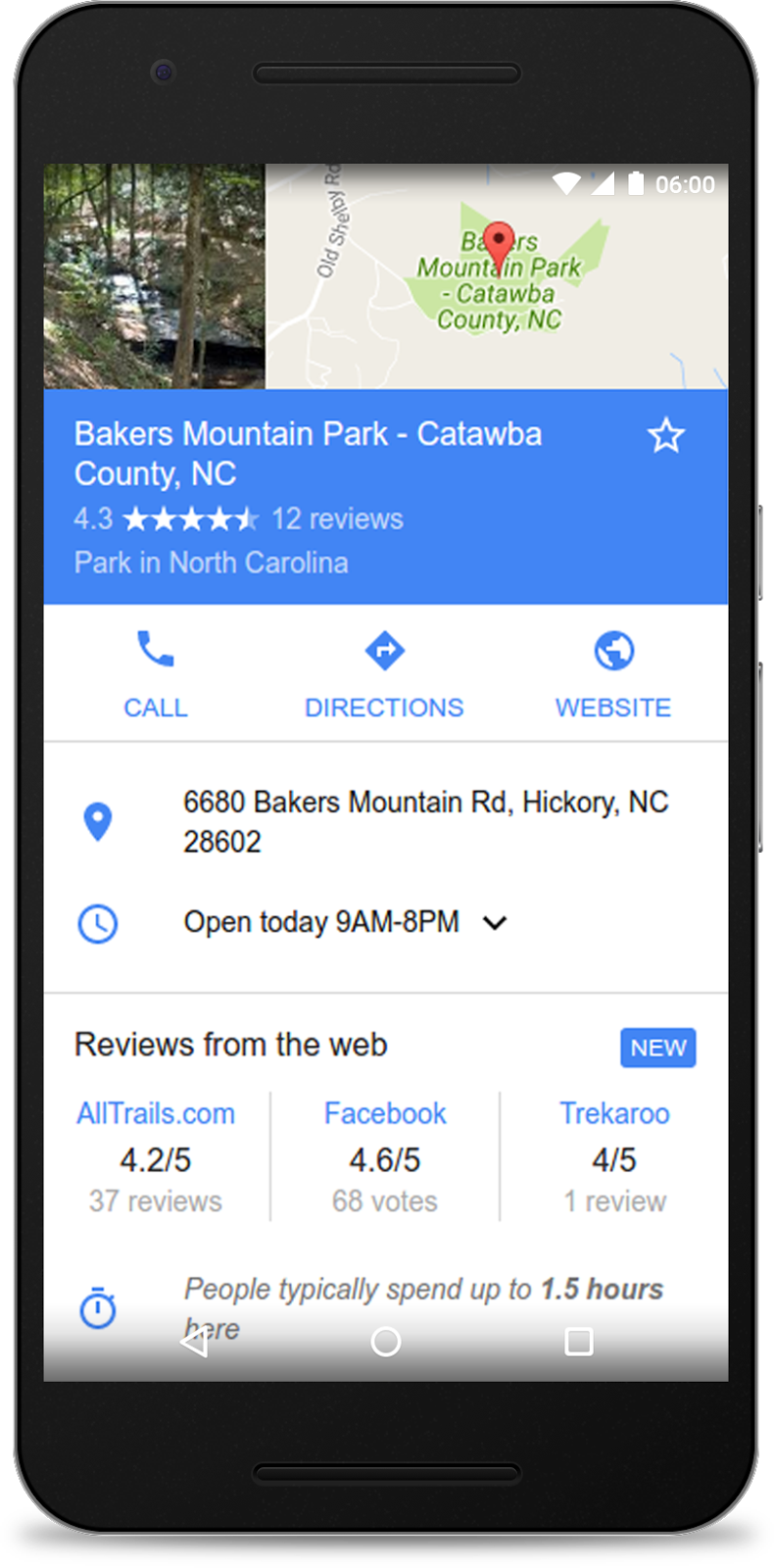
Today, we’re introducing Reviews from the web to local Knowledge Panels, to accompany our recently launched best-of lists and critic reviews features. Whether your site publishes editorial critic reviews, best-of places lists, or aggregates user ratings, this content can be featured in local Knowledge Panels when users are looking for places to go.
Reviews from the web
Available globally on mobile and desktop, Reviews from the web brings aggregated user ratings of up to three review sites to Knowledge Panels for local places across many verticals including shops, restaurants, parks and more.
By implementing review snippet markup and meeting our criteria, your site’s user-generated composite ratings will be eligible for inclusion. Add the Local Business markup to help Google match reviews to the right review subject and help grow your site’s coverage. For more information on the guidelines for the Reviews from the web, critic review and top places lists features, check out our developer site.
 Critic reviews
In the U.S. on mobile and desktop, qualifying publishers can participate in the critic review feature in local Knowledge Panels. Critic reviews possess an editorial tone of voice and have an opinionated position on the local business, coming from an editor or on-the-ground expert. For more information on how to participate, see the details in ourcritic reviews page.
 The local information across Google Search helps millions of people, every day, discover and share great places. If you have any questions, please visit our webmaster forums.
Reviews from the web
Available globally on mobile and desktop, Reviews from the web brings aggregated user ratings of up to three review sites to Knowledge Panels for local places across many verticals including shops, restaurants, parks and more.
By implementing review snippet markup and meeting our criteria, your site’s user-generated composite ratings will be eligible for inclusion. Add the Local Business markup to help Google match reviews to the right review subject and help grow your site’s coverage. For more information on the guidelines for the Reviews from the web, critic review and top places lists features, check out our developer site.
In the U.S. on mobile and desktop, qualifying publishers can participate in the critic review feature in local Knowledge Panels. Critic reviews possess an editorial tone of voice and have an opinionated position on the local business, coming from an editor or on-the-ground expert. For more information on how to participate, see the details in ourcritic reviews page.

More Safe Browsing Help for Webmasters
Wednesday, September 07, 2016
(Crossposted from the Google Security Blog.)
For more than nine years, Safe Browsing has helped webmasters via Search Console with information about how to fix security issues with their sites. This includes relevant Help Center articles, example URLs to assist in diagnosing the presence of harmful content, and a process for webmasters to request reviews of their site after security issues are addressed. Over time, Safe Browsing has expanded its protection to cover additional threats to user safety such as Deceptive Sites and Unwanted Software.
To help webmasters be even more successful in resolving issues, we’re happy to announce that we’ve updated the information available in Search Console in the Security Issues report.

The updated information provides more specific explanations of six different security issues detected by Safe Browsing, including malware, deceptive pages, harmful downloads, and uncommon downloads. These explanations give webmasters more context and detail about what Safe Browsing found. We also offer tailored recommendations for each type of issue, including sample URLs that webmasters can check to identify the source of the issue, as well as specific remediation actions webmasters can take to resolve the issue.
We on the Safe Browsing team definitely recommend registering your site in Search Console even if it is not currently experiencing a security issue. We send notifications through Search Console so webmasters can address any issues that appear as quickly as possible.
Our goal is to help webmasters provide a safe and secure browsing experience for their users. We welcome any questions or feedback about the new features on the Google Webmaster Help Forum, where Top Contributors and Google employees are available to help.
For more information about Safe Browsing’s ongoing work to shine light on the state of web security and encourage safer web security practices, check out our summary of trends and findings on the Safe Browsing Transparency Report. If you’re interested in the tools Google provides for webmasters and developers dealing with hacked sites, this video provides a great overview.
For more than nine years, Safe Browsing has helped webmasters via Search Console with information about how to fix security issues with their sites. This includes relevant Help Center articles, example URLs to assist in diagnosing the presence of harmful content, and a process for webmasters to request reviews of their site after security issues are addressed. Over time, Safe Browsing has expanded its protection to cover additional threats to user safety such as Deceptive Sites and Unwanted Software.
To help webmasters be even more successful in resolving issues, we’re happy to announce that we’ve updated the information available in Search Console in the Security Issues report.

We on the Safe Browsing team definitely recommend registering your site in Search Console even if it is not currently experiencing a security issue. We send notifications through Search Console so webmasters can address any issues that appear as quickly as possible.
Our goal is to help webmasters provide a safe and secure browsing experience for their users. We welcome any questions or feedback about the new features on the Google Webmaster Help Forum, where Top Contributors and Google employees are available to help.
For more information about Safe Browsing’s ongoing work to shine light on the state of web security and encourage safer web security practices, check out our summary of trends and findings on the Safe Browsing Transparency Report. If you’re interested in the tools Google provides for webmasters and developers dealing with hacked sites, this video provides a great overview.
Helping users easily access content on mobile
Tuesday, August 23, 2016
In Google Search, our goal is to help users quickly find the best answers to their questions, regardless of the device they’re using. Today, we’re announcing two upcoming changes to mobile search results that make finding content easier for users.
Pages that show intrusive interstitials provide a poorer experience to users than other pages where content is immediately accessible. This can be problematic on mobile devices where screens are often smaller. To improve the mobile search experience, after January 10, 2017, pages where content is not easily accessible to a user on the transition from the mobile search results may not rank as highly.
Here are some examples of techniques that make content less accessible to a user:

An example of an intrusive popup
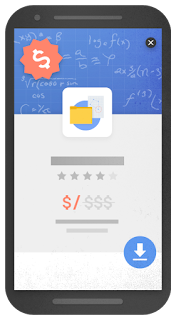
An example of an intrusive standalone interstitial
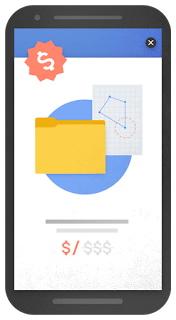
Another example of an intrusive standalone interstitial
By contrast, here are some examples of techniques that, used responsibly, would not be affected by the new signal:
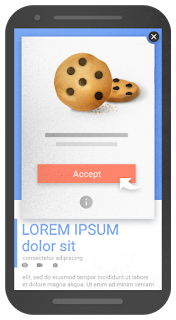
An example of an interstitial for cookie usage
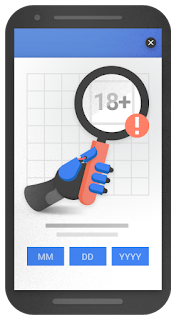
An example of an interstitial for age verification
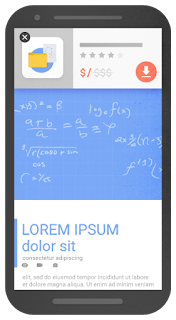
An example of a banner that uses a reasonable amount of screen space
We previously explored a signal that checked for interstitials that ask a user to install a mobile app. As we continued our development efforts, we saw the need to broaden our focus to interstitials more generally. Accordingly, to avoid duplication in our signals, we've removed the check for app-install interstitials from the mobile-friendly test and have incorporated it into this new signal in Search.
Remember, this new signal is just one of hundreds of signals that are used in ranking. The intent of the search query is still a very strong signal, so a page may still rank highly if it has great, relevant content. As always, if you have any questions or feedback, please visit our webmaster forums.
Simplifying mobile search results
Two years ago, we added a mobile-friendly label to help users find pages where the text and content was readable without zooming and the tap targets were appropriately spaced. Since then, we’ve seen the ecosystem evolve and we recently found that 85% of all pages in the mobile search results now meet this criteria and show the mobile-friendly label. To keep search results uncluttered, we’ll be removing the label, although the mobile-friendly criteria will continue to be a ranking signal. We’ll continue providing the mobile usability report in Search Console and the mobile-friendly test to help webmasters evaluate the effect of the mobile-friendly signal on their pages.Helping users find the content they’re looking for
Although the majority of pages now have text and content on the page that is readable without zooming, we’ve recently seen many examples where these pages show intrusive interstitials to users. While the underlying content is present on the page and available to be indexed by Google, content may be visually obscured by an interstitial. This can frustrate users because they are unable to easily access the content that they were expecting when they tapped on the search result.Pages that show intrusive interstitials provide a poorer experience to users than other pages where content is immediately accessible. This can be problematic on mobile devices where screens are often smaller. To improve the mobile search experience, after January 10, 2017, pages where content is not easily accessible to a user on the transition from the mobile search results may not rank as highly.
Here are some examples of techniques that make content less accessible to a user:
- Showing a popup that covers the main content, either immediately after the user navigates to a page from the search results, or while they are looking through the page.
- Displaying a standalone interstitial that the user has to dismiss before accessing the main content.
- Using a layout where the above-the-fold portion of the page appears similar to a standalone interstitial, but the original content has been inlined underneath the fold.
Examples of interstitials that make content less accessible

An example of an intrusive popup
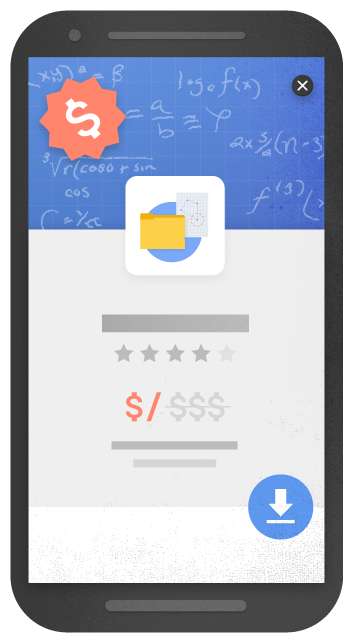
An example of an intrusive standalone interstitial
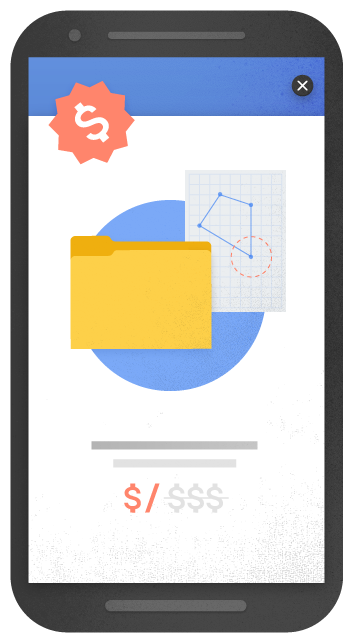
Another example of an intrusive standalone interstitial
- Interstitials that appear to be in response to a legal obligation, such as for cookie usage or for age verification.
- Login dialogs on sites where content is not publicly indexable. For example, this would include private content such as email or unindexable content that is behind a paywall.
- Banners that use a reasonable amount of screen space and are easily dismissible. For example, the app install banners provided by Safari and Chrome are examples of banners that use a reasonable amount of screen space.
Examples of interstitials that would not be affected by the new signal, if used responsibly
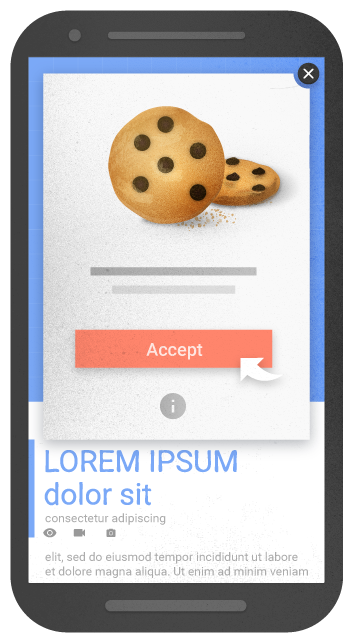
An example of an interstitial for cookie usage
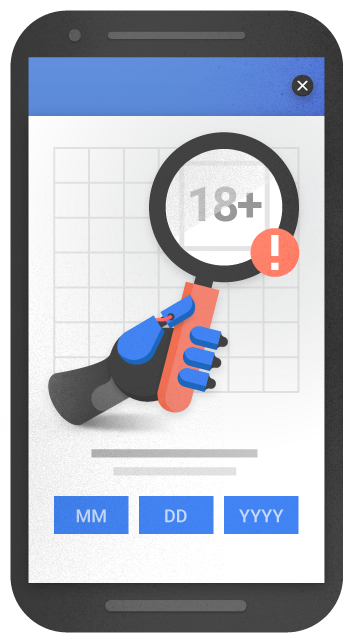
An example of an interstitial for age verification
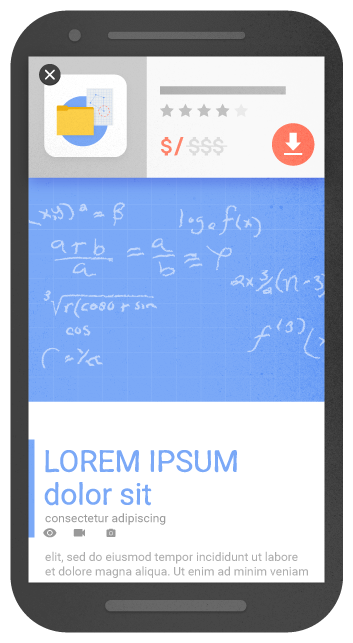
An example of a banner that uses a reasonable amount of screen space
Remember, this new signal is just one of hundreds of signals that are used in ranking. The intent of the search query is still a very strong signal, so a page may still rank highly if it has great, relevant content. As always, if you have any questions or feedback, please visit our webmaster forums.
Promote your local businesses reviews with schema.org markup
Friday, August 12, 2016
Since the launch of critic reviews last year, we have been focused on supporting more types of reviews, like restaurant reviews, cafes, or any other type of a local business. Recently we’ve announced the availability of critic reviews for local businesses. By incorporating structured data to their sites, publishers can promote their content onlocal Knowledge Graph cards and users can enjoy a range of reviews and opinions.
Critic reviews are available across mobile, tablet and desktop, allowing publishers to increase the visibility of their reviews and expose their reviews to new audiences, whenever a local Knowledge Graph card is surfaced. English reviews for businesses in the US are already supported and we’ll very soon support many other languages and countries.
 Publishers with critic reviews for local entities can get up and running by selecting snippets of reviews from their sites and annotating them and the associated business with schema.org markup. This process, detailed in our critic reviews markup instructions, allows publishers to communicate to Google which snippet they prefer, what URL is associated with the review and other metadata about the local business that allows us to ensure that we’re showing the right review for the right entity.
Google can understand a variety of markup formats, including the JSON-LD data format, which makes it easier than ever to incorporate structured data about reviews into webpages! Publishers can get started here. And as always, if you have any questions, please visit our webmaster forums.
Critic reviews are available across mobile, tablet and desktop, allowing publishers to increase the visibility of their reviews and expose their reviews to new audiences, whenever a local Knowledge Graph card is surfaced. English reviews for businesses in the US are already supported and we’ll very soon support many other languages and countries.

Google can understand a variety of markup formats, including the JSON-LD data format, which makes it easier than ever to incorporate structured data about reviews into webpages! Publishers can get started here. And as always, if you have any questions, please visit our webmaster forums.
AMP your content - A Preview of AMP'ed results in Search
Tuesday, August 02, 2016
It's 2016 and it's hard to believe that browsing the web on a mobile phone can still feel so slow with users abandoning sites that just don't load quickly. To us — and many in the industry — it was clear that something needed to change. That was why we started working with the Accelerated Mobile Pages Project, an open source initiative to improve the mobile web experience for everyone.
Less than six months ago, we started sending people to AMP pages in the “Top stories” section of the Google Search Results page on mobile phones. Since then, we’ve seen incredible global adoption of AMP that has gone beyond the news industry to include e-commerce, entertainment, travel, recipe sites and so on. To date we have more than 150 million AMP docs in our index, with over 4 million new ones being added every week. As a result, today we’re sharing an early preview of our expanded AMP support across the entire search results page --not just the “Top stories” section.
To clarify, this is not a ranking change for sites. As a result of the growth of AMP beyond publishers, we wanted to make it easier for people to access this faster experience. The preview shows an experience where web results that that have AMP versions are labeled with . When you tap on these results, you will be directed to the corresponding AMP page within the AMP viewer.


AMP in Search Preview
Try it out for yourself on your mobile device by navigating to g.co/ampdemo. Once you’re in the demo, search for something like “french toast recipe” or music lyrics by your favorite artist to experience how AMP can provide a speedier reading experience on the mobile web. The “Who” page on AMPProject.org has a flavor of some of the sites already creating AMP content.
We’re starting with a preview to get feedback from users, developers and sites so that we can create a better Search experience when we make this feature more broadly available later this year. In addition, we want to give everyone who might be interested in “AMPing up” their content enough time to learn how to implement AMP and to see how their content appears in the demo. And beyond developing AMP pages, we invite everyone to get involved and contribute to the AMP Project.
We can’t wait to hear from you as we work together to speed up the web. And as always, if you have any questions, please visit our webmaster forums.
Less than six months ago, we started sending people to AMP pages in the “Top stories” section of the Google Search Results page on mobile phones. Since then, we’ve seen incredible global adoption of AMP that has gone beyond the news industry to include e-commerce, entertainment, travel, recipe sites and so on. To date we have more than 150 million AMP docs in our index, with over 4 million new ones being added every week. As a result, today we’re sharing an early preview of our expanded AMP support across the entire search results page --not just the “Top stories” section.
To clarify, this is not a ranking change for sites. As a result of the growth of AMP beyond publishers, we wanted to make it easier for people to access this faster experience. The preview shows an experience where web results that that have AMP versions are labeled with
. When you tap on these results, you will be directed to the corresponding AMP page within the AMP viewer.

AMP in Search Preview
Try it out for yourself on your mobile device by navigating to g.co/ampdemo. Once you’re in the demo, search for something like “french toast recipe” or music lyrics by your favorite artist to experience how AMP can provide a speedier reading experience on the mobile web. The “Who” page on AMPProject.org has a flavor of some of the sites already creating AMP content.
We’re starting with a preview to get feedback from users, developers and sites so that we can create a better Search experience when we make this feature more broadly available later this year. In addition, we want to give everyone who might be interested in “AMPing up” their content enough time to learn how to implement AMP and to see how their content appears in the demo. And beyond developing AMP pages, we invite everyone to get involved and contribute to the AMP Project.
We can’t wait to hear from you as we work together to speed up the web. And as always, if you have any questions, please visit our webmaster forums.